Journal / Style
4 October 2026 · 6 min read
How to stack gold jewellery without looking busy
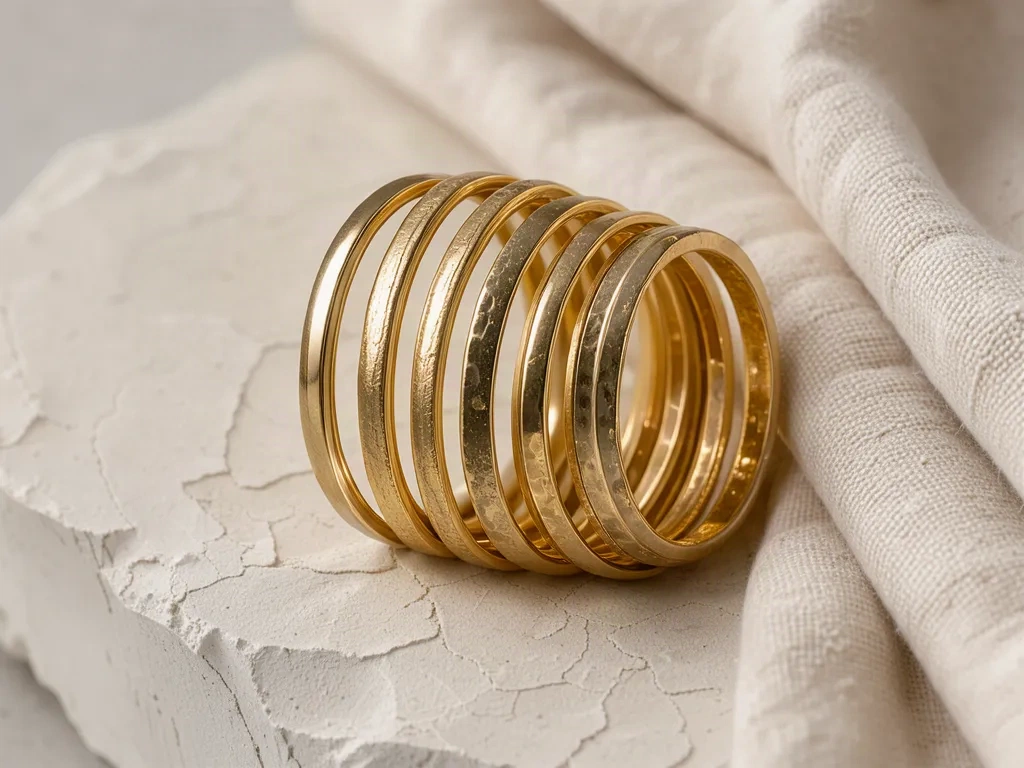
Stacking is the easiest trend of the season, and the easiest to get wrong. Done well, a stack of gold rings and bracelets looks considered — a private collection of meaningful pieces. Done carelessly, it looks like a set of charms that fell off a charm bracelet. I have been watching wrists for twenty years, and the difference is almost never the number of pieces. It is the widths, the metals, and the rule of two.
Why it works
The market has confirmed what the bench has known for a while. In September 2026, JCK — the American jewellery trade publication — covered stacking as one of the defining habits of the moment, and noted that it is no longer a women's story: men are stacking too, signet rings beside flat bands, a heavy chain with a thin one. And the numbers back it up. Kay, the US retailer, reported unit growth of just over 9% in its men's jewellery category from fiscal 2025 to fiscal 2026.
Why does it work? Because a stack is personal in a way a single piece cannot be. It says the wearer chose each element over time — a birthday band, an inherited ring, a chain that has never left the wrist. That is "quiet luxury" in its true sense: the value is in the individual history, not in the logo.
It is also the most economical way to make a statement in solid gold. Three pieces at three hundred to four hundred euros each read as a deliberate collection; a single heavy piece at twice the price reads as just one more object. The stack multiplies the meaning of the gold you already own.
The rule of two
My first rule is the rule of two: one thin piece and one medium piece, never three of the same width. Three identical 2 mm bands read as a matching set — uniform, factory-like, busy. A 1.2 mm chain next to a 3 mm band reads as a deliberate composition: a fine line and a solid statement, each making the other look better.
The rule applies per hand and per wrist. A stack of three rings on one hand works if the widths differ — thin, medium, thin again. The eye needs a rest between the strong shapes. When every element competes at the same volume, the whole thing becomes noise.
The widths that work together
In our collection, three widths cover almost every combination: 1.2 mm, 2 mm and 3 mm. The finest line is for the pieces that should whisper — a delicate chain at the wrist, a ring worn closest to the hand. The medium 2 mm is the everyday workhorse. The 3 mm is the statement, the band that carries weight.
Think about the hand itself. A long, slender finger can take a 3 mm band and still look elegant; a shorter finger reads better with the medium width, with the thin ring placed above it. On the wrist, the reverse is useful: the thin chain near the hand, the wider bangle higher up. The pieces echo the proportions of the body, and that is what makes a stack look like it belongs.
If you wear the same stack every day, choose widths that let the pieces move without grinding: a 1.2 mm link beside a 3 mm band has room to breathe, while two identical widths sit flush and wear against each other. The rule of two protects the metal as much as the eye.
The one mistake
The mistake that makes solid gold look like costume jewellery is mixing yellow gold and rose gold side by side in the same stack. The two tones pull against each other — the eye cannot settle on either, and the stack reads as uncertain, accidental, cheap. It is the single fastest way to undo the effect of solid metal.
The advice I give is simple: two tones, one shine. You may wear yellow and rose in different stacks — a rose ring on one hand, yellow on the other — but within a single stack, keep one metal. And match the finish: all matte, or all polished, or one texture repeated. Hammered with hammered, brushed with brushed. Consistency of shine is what makes multiple pieces read as one intentional composition.
The combo of the moment
The stack we are making most at the bench right now is a ring stack, in 18-carat yellow gold: the Baguette Band, a flat 3 mm band with a mirror polish, on the middle finger; the Antique Wash Ring, hammered and brushed, on the index finger; and the Céleste chain, a flat curb link at 2.4 mm, at the wrist.
Notice the structure: a solid unbroken band, a textured band, and a chain that moves. Three different surfaces, one metal, one shine language — matte next to mirror, but all yellow. It is the rule of two, extended across the hand.
How to clean a stack
A stack collects more than a single piece: skin oils, soap, dust between the bands. The routine we use in the atelier is the one I recommend at home. Take the stack apart — every ring, every chain, separately. Wash each piece in warm water with a drop of mild soap, brushing gently with a soft-bristle brush. Rinse, dry on a soft cloth, and rebuild the stack. Ten minutes, once a month.
Do not wear the stack to the pool, the gym, or anywhere it will meet chlorine or hard knocks. Gold does not tarnish, but the alloy metals — copper and silver — can react, and a knock can deform a thin band. Separate, clean, rebuild: that is the whole ritual.

Emily Rose
Emily Rose is a goldsmith who has worked at the bench for more than twenty years. She writes for infoBijoux, the French jewellery trade media, and keeps this journal from her atelier at 14 rue de Saintonge in Paris.
Build your stack
The rings and chains above are made to order in Paris, shipped within 48 hours, with the lifetime repair service on every piece.