Paris · Le Marais
The atelier
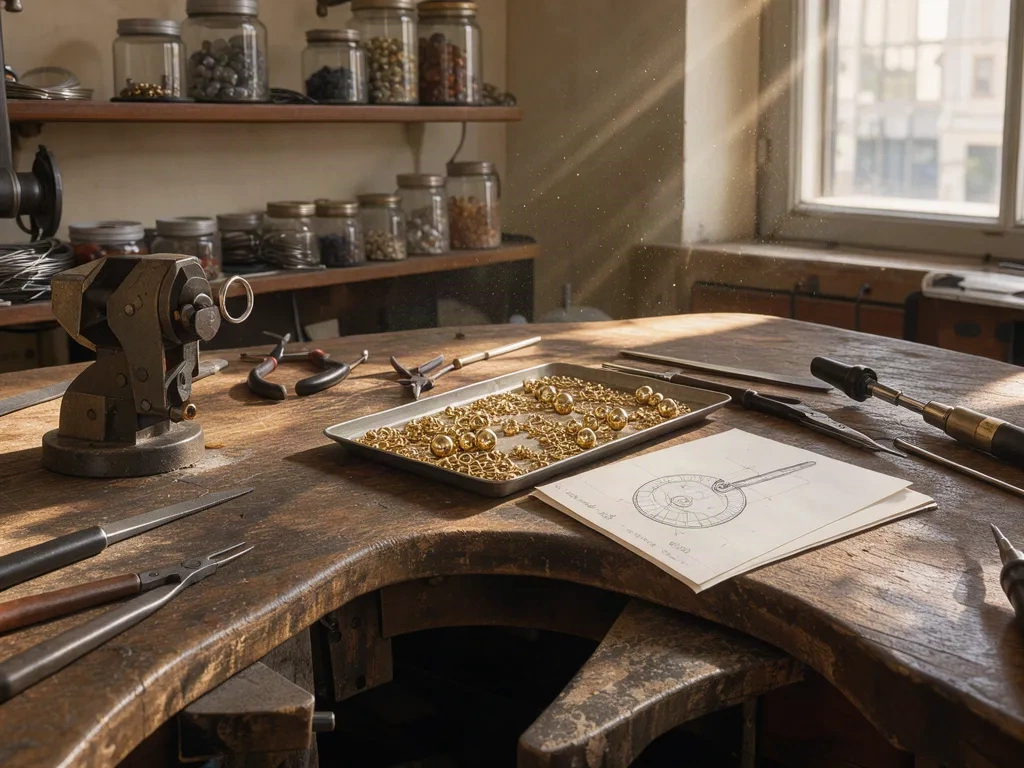
Every Emily Rose piece starts as a drawing and ends as a hallmarked 18k gold object. Four steps, one pair of hands, a bench in the Marais.
How a piece is made
Four steps, one pair of hands
No division of labour, no subcontracting. Each piece moves through the same four steps, at the same bench, under the same hands.
-
1. Drawing and wax
A piece begins as a 1:1 drawing, then a model carved in wax. The wax is the blueprint: its weight, its profile, its seams become the piece itself. The lost-wax process — cire perdue — is the one the Greeks and Romans described, and it has barely changed since.
-
2. Forging and casting
The gold arrives as recycled 18k alloy: 750‰ gold, 20% copper, 5% silver. It is melted in a crucible and cast into the mould the wax leaves behind. What is better worked by hammer than by cast — the oval links of the Local Link bracelet, the shanks of the rings — is forged at the bench.
-
3. Setting and fitting
Stone setting — le serti — is done with a graver and a pusher, not a machine. Shanks are filed and fitted to the finger, joints assembled, soldering finished. This is the step where a cast stops being a cast and becomes something wearable.
-
4. Polishing and hallmarking
The surface is brought to its finish — mirror polish, brushed, or hammered (martelée). Last comes the law: the eagle's head of the French guarantee and the maker's responsibility punch are struck into the metal before the piece leaves.
The atelier vocabulary
Words you will meet again
These French terms appear on our certificates, in the workshop, and on the site. Here is what they mean.
| French | English |
|---|---|
| cire perdue | lost-wax casting |
| alliage | alloy |
| serti | prong setting |
| martelée | hammered finish |
| polie miroir | mirror-polished |
| bruni | burnished |
| grenaille | granulation |
| fermoir | clasp |
| poinçon | hallmark |
| poinçonneuse | hallmarking machine |
| certificat d'authenticité | certificate of authenticity |
Small series
Twelve pieces a season
Twelve is not a marketing number. It is the yield of one bench: twelve pieces per season, each designed, made and finished by the same pair of hands. There is no faster way that does not change what a piece is.
It is why the catalogue is short, why a sold-out design stays sold out until the season turns, and why every piece can carry the name of the person who made it.
The law on the metal
Made in France, marked in France
Every piece over three grams carries two punches. The state guarantee — for 18k gold, the eagle's head in a hexagon — certifies the fineness. Beside it stands the maker's responsibility mark, a lozenge that identifies the atelier. Both are struck at the bench, not added later.
This is a system founded by the law of 19 Brumaire, Year VI — 9 November 1797 — with the current marks in use since 10 May 1838. It is one of the oldest consumer protection laws in Europe, and it still does its job.
Talk to the bench
See the pieces, or write to the atelier
If a question is about a specific piece, the person who made it will answer it. Appointments at 14 rue de Saintonge are on request.