Journal / Craft
21 September 2026 · 8 min read
A day at the bench: notes from a Paris jewellery atelier
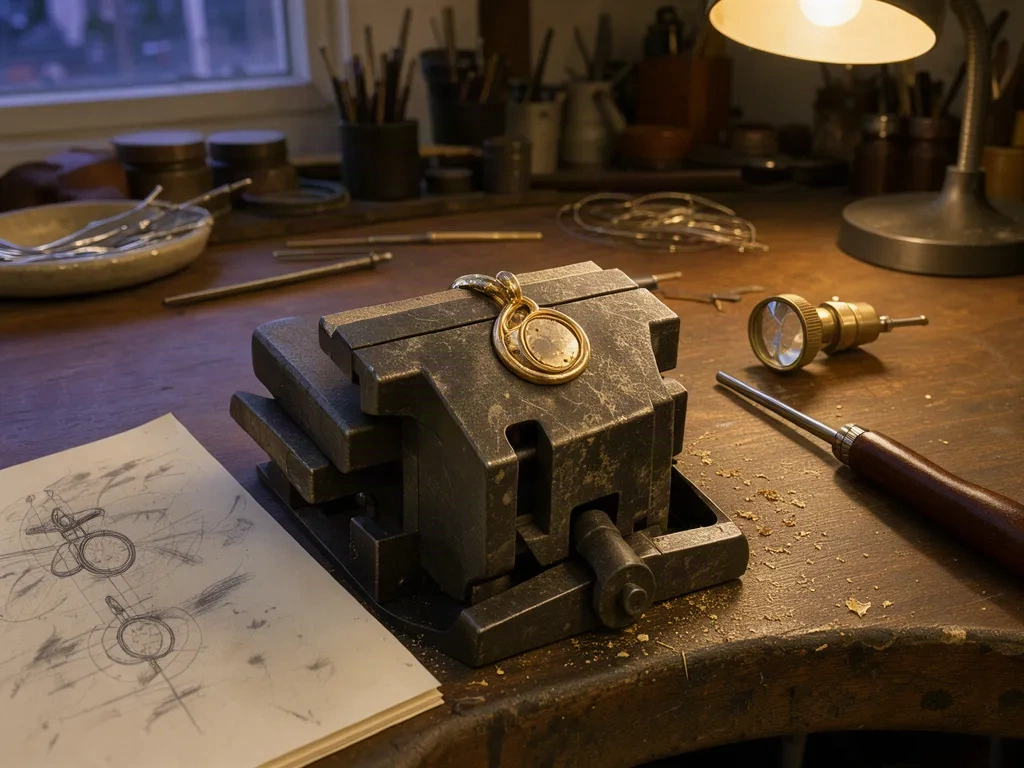
There are two of us at the bench, in a room behind the glass at 14 rue de Saintonge. We make twelve pieces a season, and we finish everything ourselves. This is what a working day actually looks like — the parts that end up in photographs, and the parts that do not.
8:30 — the drawing
Every piece starts with a drawing, made by hand at 1:1 — the ring drawn at the size it will actually be. Nobody sees these drawings, and that is the point. A pencil line forces decisions a screen does not: how wide the shoulder should be, how the light will fall on a curve, whether the profile still looks right when it is only millimetres tall.
The drawing is checked against the gold price before anything else. A design that looks generous on paper may be wasteful in metal, and with gold at today's prices, the drawing is also a budget. We measure, we weigh, we adjust. Only then does the piece go to the wax.
The drawing is also the first quality control. We draw the profile, the plan and the section, and write the target weight at the bottom of the sheet, in grams. When the casting comes out of the flask, it is weighed against that number. A ring heavy by half a gram is not a gift; it is a mistake to understand before it repeats.
10:00 — the wax
The next step is lost-wax casting, a process so old that it was documented in antiquity. The oldest gold artefacts ever found — the ornaments of the Varna Necropolis, on the Bulgarian coast of the Black Sea — date to around 4550 to 4450 BC, and they were made by the same family of techniques we use: a model is carved, encased, melted away, and replaced by metal.
We carve the model in wax at the bench — slowly, with the same files and gravers we will use on the gold. The wax is mounted on a sprue, a little tree of channels, so the molten metal can reach every corner. This is where the piece is fully decided: proportion, surface, edge. The wax is the promise; the gold is the keeping of it.
13:00 — the casting
At lunch the crucible comes out. We cast in 18-carat gold — 750 parts per thousand — in the French legal alloy of 75% gold, 20% copper and 5% silver. We weigh the grain, we melt it, and we pour it into the flask that holds the burned-out wax mould.
Casting is the least forgiving hour of the day. If the metal is too cool, it will not fill the fine details; too hot, and it can seize the mould. The temperature window is narrow, and the flask is too hot to hold. We trust the timer, the pyrometer, and the habits of twenty years. When the metal cools, we break the mould and find the rough casting — a pale, gritty version of the ring, already recognisable.
15:00 — the fitting
The rough casting is never the finished piece. The afternoon is the fitting: sawing off the sprue, filing the inside of the band, seating the stones. The setting — the serti — is where a ring proves itself. A stone must sit level, secure, and open to the light; the metal around it has to be worked with files and a burnisher until the prongs hold without ever being seen to hold.
This is slow, quiet work. A single prong can take half an hour to shape and set. The pieces that look simplest are often the ones that took the longest — the plain band that must catch the light evenly around its whole circumference, the flat curb link that must lie perfectly flat against the wrist.
Every file stroke changes the geometry, so we work in passes: fit, check under the lamp, fit again. The burnisher does the final tightening — a polished steel tool that compresses the metal, hardening the surface as it shines. That is also why a hand-finished piece wears differently from a machine-cleaned one: the surface is denser where it matters.
17:00 — the polish and the punch
Then the polishing: wheels and compounds, from coarse to fine, until the surface holds a mirror or the soft matte we have chosen. After the last wheel, the piece is washed, dried, and inspected under the lamp.
The final act is the punch. Every piece of 18-carat gold we make carries the eagle's head — the French hallmark for 750 thousandths, stamped inside a hexagon — and next to it, our responsibility punch, the maker's lozenge. Two stamps, side by side: one for the state, one for the person who made it. (Pieces under three grams of gold are exempt from the title hallmark, but the responsibility punch always stays.) Each finished piece leaves with a certificate of authenticity recording the alloy, the weight and the stamps — signed and dated.
What goes back in the tray
Not every piece makes it. A casting that comes out short, a prong that breaks on the last set, a polish that goes through a corner — these happen, more often than the website lets on. They are not errors to hide; they are the cost of doing the work honestly.
What goes back in the tray goes back into the melt. The failed ring is weighed, returned to the crucible, and becomes part of the next casting. Nothing is thrown away, and nothing is sold with a flaw. The tray is the quiet half of the day — the half that keeps the promise of the other half.
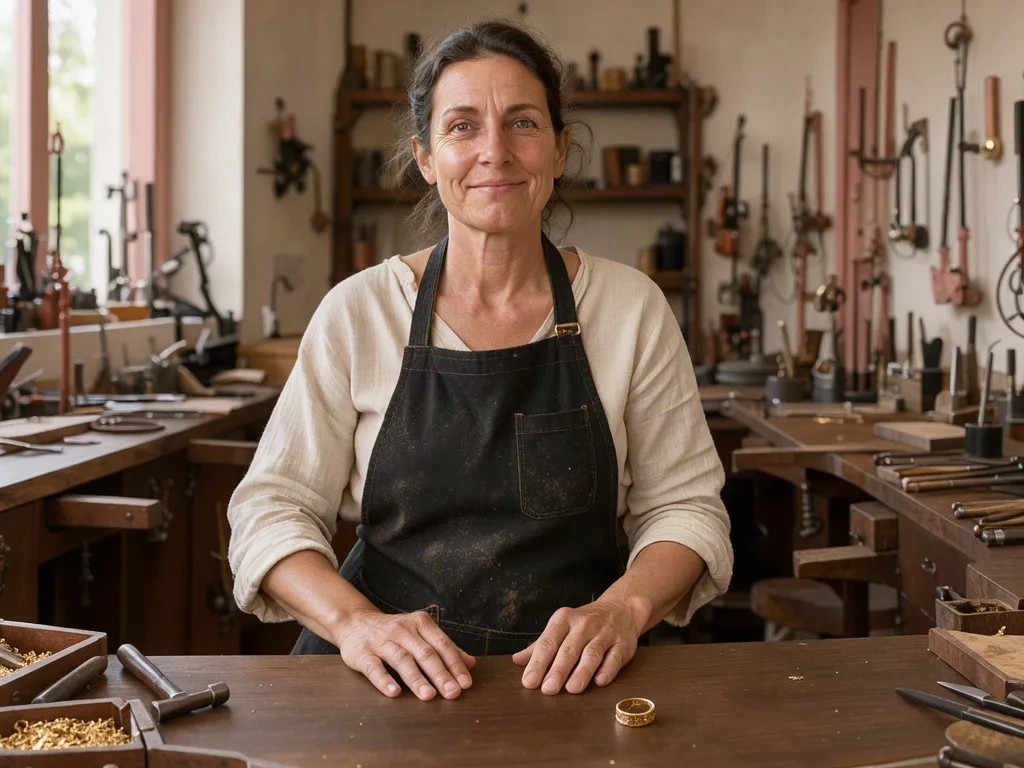
Emily Rose
Emily Rose is a goldsmith who has worked at the bench for more than twenty years. She writes for infoBijoux, the French jewellery trade media, and keeps this journal from her atelier at 14 rue de Saintonge in Paris.
Come and see the bench
The atelier at 14 rue de Saintonge is open Monday to Friday — and every piece in the collection is made here, by hand, in 18-carat gold.